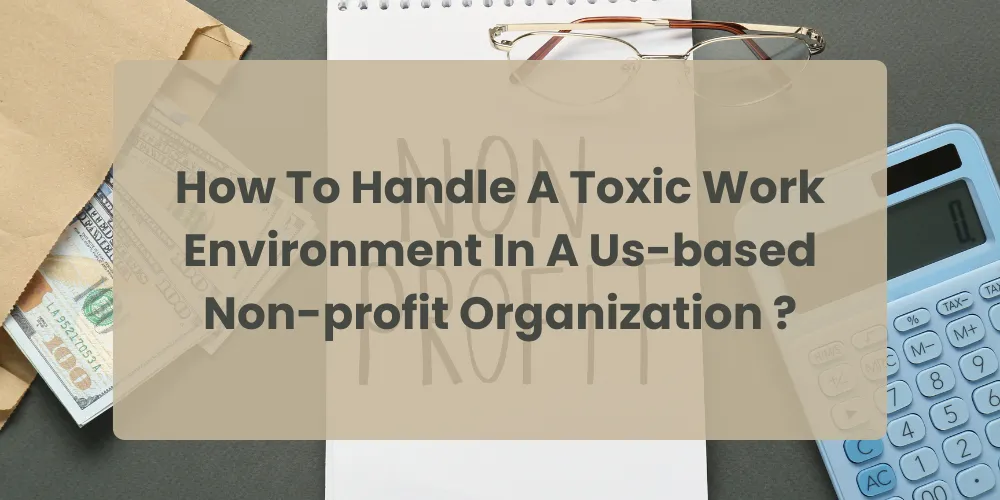
How To Handle A Toxic Work Environment In A Us-based Non-profit Organization ?
If you’re searching for how to handle a toxic work environment in a US-based non-profit organization, you’re likely feeling conflicted. You believe in the mission—but the culture is draining you. I’ve advised non-profits across the U.S. for over 15 years, and this is one of the most emotionally complex workplace challenges I see.
Non-profit toxicity hits differently. The cause is noble. The funding is fragile. And too often, that combination is used to justify behavior that would never fly in the private sector.
Let’s talk honestly about what’s happening, what actually works, and what most advice online gets dangerously wrong.
A Real Story From the Field (Why Non-profit Toxicity Is So Hard to Spot)
About eight years ago, I worked with a mid-sized education non-profit in the Midwest. Staff turnover was sky-high, but leadership blamed “burnout” and “lack of passion.”
When I interviewed employees, the pattern was obvious:
- Chronic micromanagement
- Public shaming masked as “accountability”
- Unrealistic workloads justified by “we’re mission-driven”
One program director told me, “If I complain, I feel like I’m betraying the kids we serve.”
That sentence stuck with me—and it explains why learning how to handle a toxic work environment in a US-based non-profit organization requires a very different playbook than corporate advice blogs suggest.
What a Toxic Work Environment Looks Like in Non-profits (Specifically)
Toxicity in non-profits often hides behind good intentions.
Common Red Flags I See Repeatedly
- Mission guilt: “If you really cared, you’d stay late.”
- Chronic understaffing framed as “resourcefulness”
- Founders or executives above accountability
- Emotional labor ignored or minimized
- Retaliation disguised as ‘performance management’
Expert Insider Tip #1
Toxic non-profits rarely look chaotic. They look busy, morally righteous, and emotionally exhausting.
Why US-based Non-profits Are Uniquely Vulnerable to Toxic Culture
Understanding the system helps you respond strategically.
Structural Pressures That Enable Toxicity
- Grant deadlines tied to unrealistic deliverables
- Donor expectations overriding employee wellbeing
- Weak HR infrastructure
- Boards disconnected from day-to-day culture
This creates an environment where:
- Overwork is normalized
- Boundaries are seen as selfish
- Speaking up feels risky
How To Handle A Toxic Work Environment In A US-based Non-profit Organization
Document Everything (Without Becoming Paranoid)
Keep a private record of:
- Dates, times, and patterns
- Exact language used
- Witnesses when applicable
- Policy violations tied to behavior
This isn’t about “building a case” immediately—it’s about protecting your clarity.
Expert Insider Tip #2
Toxic environments gaslight. Documentation keeps you grounded, even if you never share it.
Separate the Mission From the Management
This is the emotional trap.
Ask yourself:
- Do I love the cause—or this workplace?
- Would this behavior be acceptable anywhere else?
- Am I staying out of fear, guilt, or hope?
You can care deeply about a mission and still leave a harmful organization.
Use Internal Channels Strategically (Not Emotionally)
Before escalating:
- Review the employee handbook
- Understand grievance procedures
- Identify neutral decision-makers
When you speak:
- Stick to behavior and impact
- Avoid moral language
- Reference policies, not feelings
Comparison Table: Healthy vs Toxic Non-profit Cultures
| Area | Healthy Non-profit | Toxic Non-profit |
|---|---|---|
| Mission | Inspires boundaries | Used to guilt staff |
| Feedback | Constructive & private | Public or punitive |
| Leadership | Accountable | Untouchable |
| Workload | Sustainable | Constant crisis |
| Burnout | Addressed | Normalized |
When HR, Boards, or Leadership Fail You (The Reality)
Here’s the information gap most articles avoid:
In many US-based non-profits, HR exists to protect funding—not employees.
That doesn’t mean you’re powerless, but it does mean you need to be realistic.
Smarter Options I Often Recommend
- Quietly consulting an employment attorney (many offer free calls)
- Reaching out to board members only with documented patterns
- Using external mediators for severe conflicts
- Planning a strategic exit while protecting references
Expert Insider Tip #3
Your goal isn’t to “fix” a toxic organization alone. Your goal is to leave with your health, reputation, and integrity intact.
Common Pitfalls & Warnings
Staying Too Long “For the Mission”
Consequence: Long-term burnout, cynicism, health issues.
Venting Without Strategy
Consequence: Being labeled “difficult” or “not a culture fit.”
Assuming Leadership Will Change
Consequence: Wasted emotional labor and stalled career growth.
Ignoring Retaliation Signals
Consequence: Sudden performance issues, exclusion, or forced exits.
Rebuilding After a Toxic Non-profit Experience
Leaving doesn’t mean failing.
What I’ve seen work:
- Reframing the experience as systems exposure
- Targeting non-profits with strong governance and transparent boards
- Asking culture-focused questions in interviews
- Setting boundaries early—even when it feels uncomfortable
Is a toxic work environment common in non-profits?
Yes. Resource scarcity, mission pressure, and weak accountability make some non-profits particularly vulnerable.
Should I report a toxic manager in a non-profit?
Only after reviewing policies and documenting patterns. Reporting without strategy can backfire.
Can a non-profit fire you for speaking up?
Legally, retaliation protections exist—but enforcement varies. This is why documentation matters.
Is it okay to leave a non-profit because of culture?
Absolutely. Protecting your wellbeing allows you to serve causes sustainably over time.
Final Thoughts: Choosing Yourself Without Abandoning Your Values
Learning how to handle a toxic work environment in a US-based non-profit organization isn’t about becoming hardened or cynical. It’s about understanding systems, power, and human limits.
You are not the mission.
You are not expendable.
And you are allowed to do meaningful work without being harmed in the process.